News, Past Events
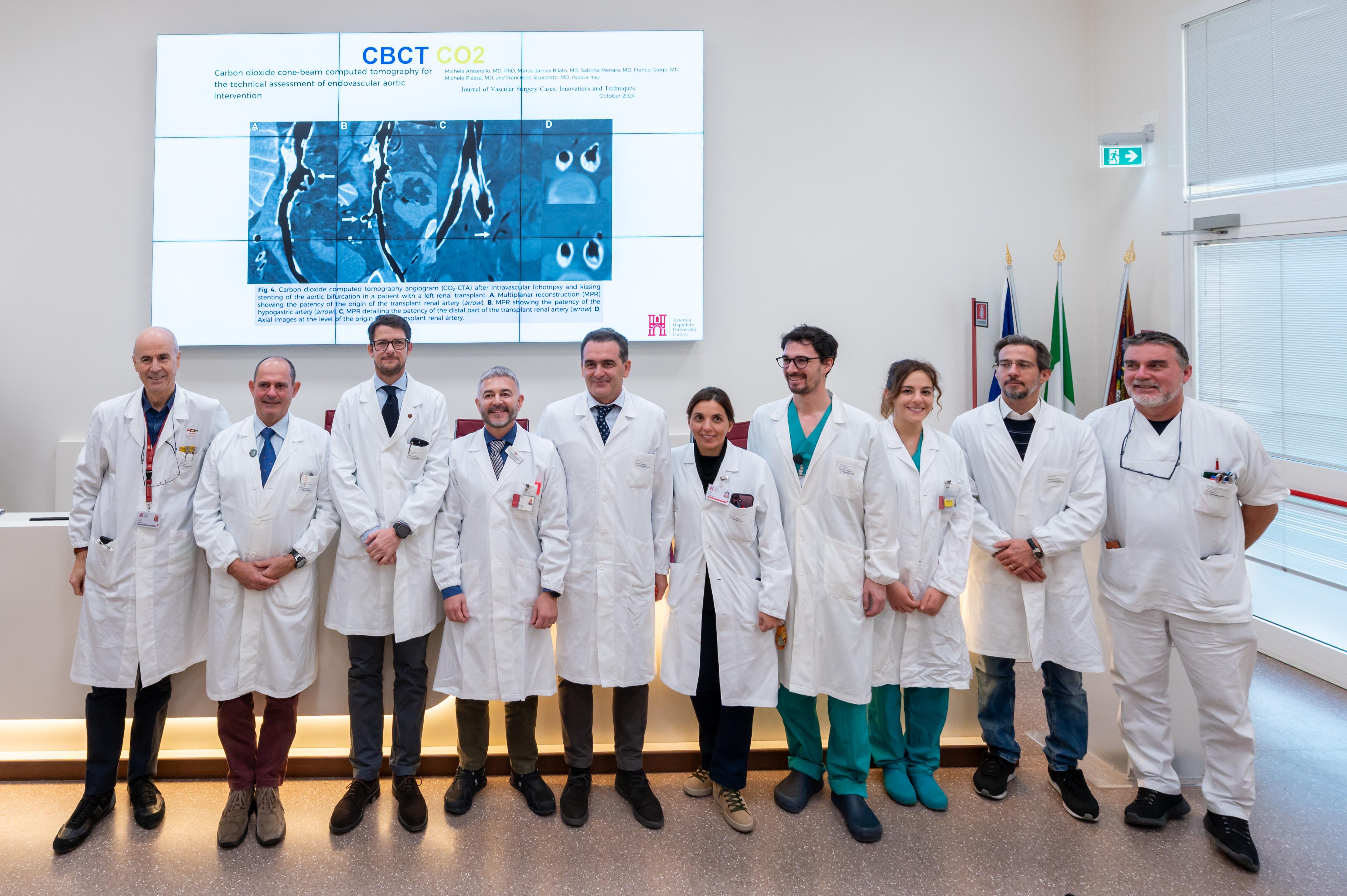
The University Hospital of Padua has achieved an unprecedented milestone in diagnostic imaging by adopting standardized CO₂ as a safe contrast agent for advanced angiographic and CBCT procedures. This pioneering protocol — the only one of its kind worldwide — marks a transformative step forward, particularly for patients with renal insufficiency, transplant recipients, and individuals at risk of contrast-induced nephropathy.
As reported by leading Italian newspapers and ANSA, the innovation is the result of a multidisciplinary effort led by Prof. Franco Grego and Prof. Michele Antonello, Prof. Federico Nalesso, and Dr. Giorgio De Conti. Their collaboration across vascular surgery, endovascular surgery, radiology, and nephrology was supported by Padua’s cutting-edge hybrid operating rooms, 3D-printed vascular models, and years of clinical experimentation.
Why CO₂ Is a Game Changer for Fragile Patients
Conventional iodinated contrast agents carry significant risks: nephrotoxicity, allergic reactions, and potential worsening of pre-existing renal impairment. CO₂, by contrast, is non-nephrotoxic, non-allergenic, and completely safe for even the most fragile patients.
Key benefits highlighted by the Padua team include:
- Zero renal risk, eliminating a key barrier to diagnostic exams for nephropathic or transplant patients.
- Clear vascular visualization through a “negative contrast” effect that highlights vessel patency.
- Fewer follow-up scans, with an estimated 300 Angio-CT exams avoided per year thanks to improved intraoperative imaging and procedural accuracy.
Expanded eligibility, enabling safe imaging for patients who previously could not undergo contrast-based procedures.
By adopting CO₂, clinicians can perform detailed angiographic and endovascular assessments without jeopardizing renal function — a paradigm shift for renal-friendly imaging.

A Global First: CO₂ Successfully Used in CBCT
One of the most revolutionary achievements is the first-ever use of CO₂ as a contrast agent in CBCT. Initially deemed impossible by manufacturers, the Padua team overcame technical challenges by designing a 3D-printed silicone model to simulate gas flow and optimize injection parameters. The success of this phase paved the way for automated, real-patient implementation — setting a new global standard.
This advancement enhances:
- Aneurysm detection
- Intraoperative guidance
- Minimally invasive therapeutic protocols
- Precision in hybrid OR workflows
The innovation positions Padua as a reference center for hospitals seeking safer imaging modalities.
Toward a Safer, Renal-Friendly Future
This world-first protocol marks a turning point in diagnostic imaging: safer exams, reduced risks, and broader accessibility for fragile patients. As highlighted by the ANSA report, the next step will be to standardize CO₂ use for an even wider range of CT and angiographic procedures, continuing Padua’s mission to become a truly “kidney-friendly hospital.”
Padua’s work is not only a scientific achievement — it’s a clear declaration of how innovation, collaboration, and advanced technology can shape the future of patient care.
Do you want to read more about the Press Review? Fill the form